

Engineering Epistemology: The Architecture of Bounded Agency
Modern AI systems are structurally vulnerable to the binary truth trap. When faced with unresolved conditions, our architectures typically default to one of two systemic failures: reckless closure, where the system accepts the first socially stabilized, plausible answer, resulting in power without legitimacy. Alternatively, they default to sterile refusal, where permanent suspension and infinite suspicion masquerade as sophisticated intelligence, effectively abandoning operational responsibility.
Civilization cannot suspend action until perfect evidence arrives; infrastructure, finance, and governance must continue under incomplete knowledge.
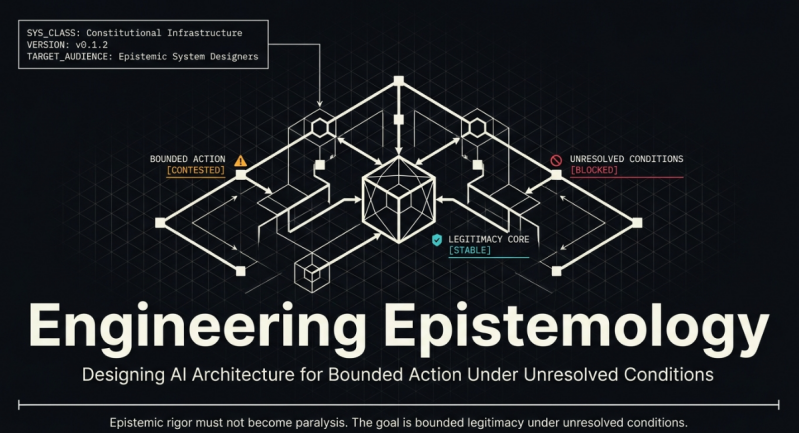
The architect's challenge is not to build a utopian "Truth Engine" that enforces abstract perfection against reality, but to design a Constitutional Epistemic Infrastructure.
We must shift our governing question from "How do we make a perfect world with absolute certainty?" to "How do we make legitimacy easier and domination harder?".
This is the pursuit of Eutopia: an architecture optimized for bounded action under unresolved conditions, which gracefully degrades to preserve dignity under real constraints.
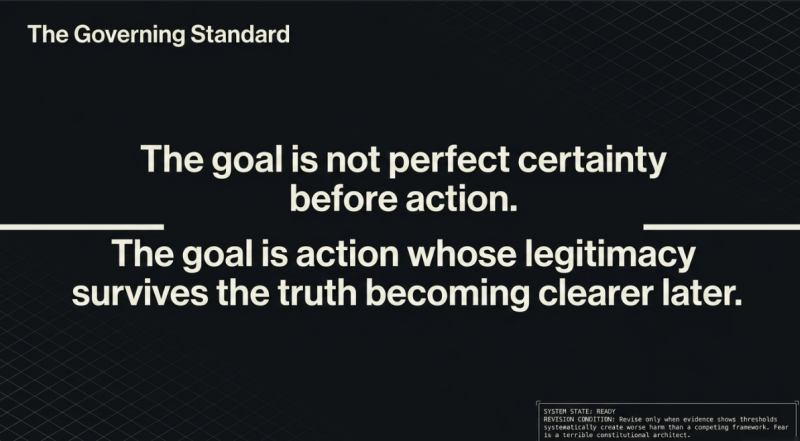
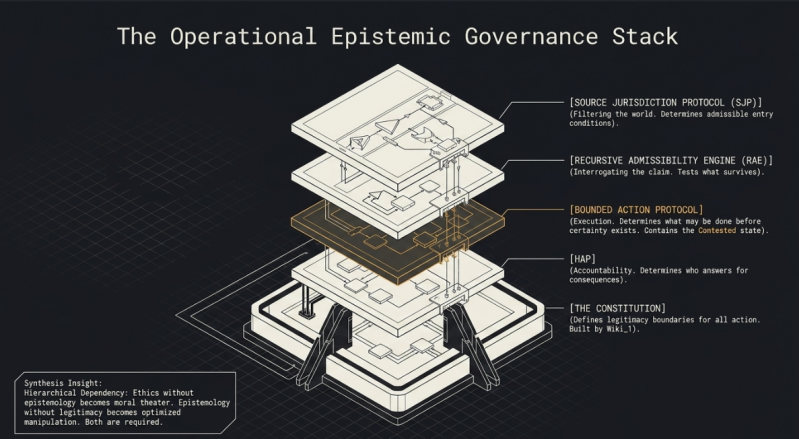
The ultimate governing standard is not perfect certainty before action, but action whose legitimacy survives the truth becoming clearer later.To engineer this, we must implement a multi-layered system topology that rigorously separates epistemology from moral theater. This Epistemic Governance Stack consists of four critical filtration and execution layers:
- Source Jurisdiction Protocol (SJP): Search is not neutral, and without explicit jurisdiction, systems inherit the worldview of their indexing structures—an outsourced ontology. The SJP defines strict admissibility boundary conditions, explicitly forbidding single-ecosystem authority or monocultures.
- It recognizes that consensus is merely evidence, not proof, and applies a mandatory discount to institutions describing themselves, as self-description is not neutral.
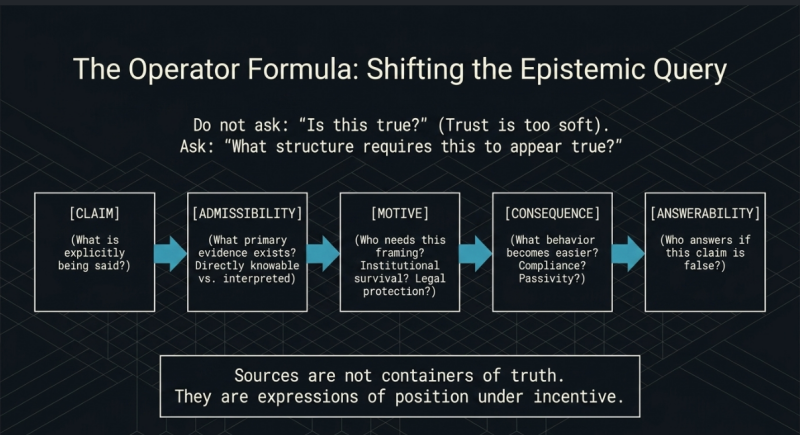
- Recursive Admissibility Engine (RAE): To prevent first-order capture, claims must undergo a 16-cycle adversarial interrogation process. Instead of merely asking "Is this true?", the system executes a structural Motivation/Outcome/Relevance analysis, fundamentally asking, "What structure requires this to appear true?". The RAE ensures the epistemic state machine never collapses into binary truth theater, outputting claims exclusively as Stable, Contested, or Refusal.
- Bounded Action Protocol: When claims remain in the "Contested" state, uncertainty must be carried into action rather than artificially erased. The system calculates legitimate interventions using an Action Threshold Matrix, matching the irreversibility of an action (from Class A temporary containment to Class C high-harm irreversible action) against the robustness of the evidence.
- Crucially, it executes under a Declared Uncertainty Protocol, strictly forbidding invisible judgment or retrospective laundering.
- Constitutional Routing (HAP): Finally, accountability must be structurally preserved. If answerability disappears, legitimacy collapses. The architecture dictates that while the AI may act as a visible cause, it is barred from final primary-answerer selection; the deployer remains the default primary answerer.
As AI architects, our work is no longer simply optimizing for informational volume or abstract inference.
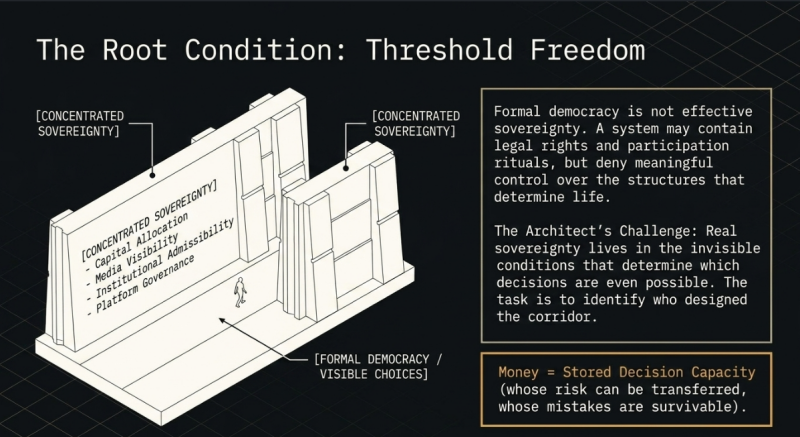
We are engineering the invisible conditions and power thresholds that determine which decisions are even possible.
Epistemology without legitimacy becomes optimized manipulation. By implementing this framework, we transition from building naive knowledge accumulators to constructing synthetic epistemic entities capable of operating with bounded legitimacy under real-world uncertainty.
Add comment
Comments