

When Possibility Stops Being an Option
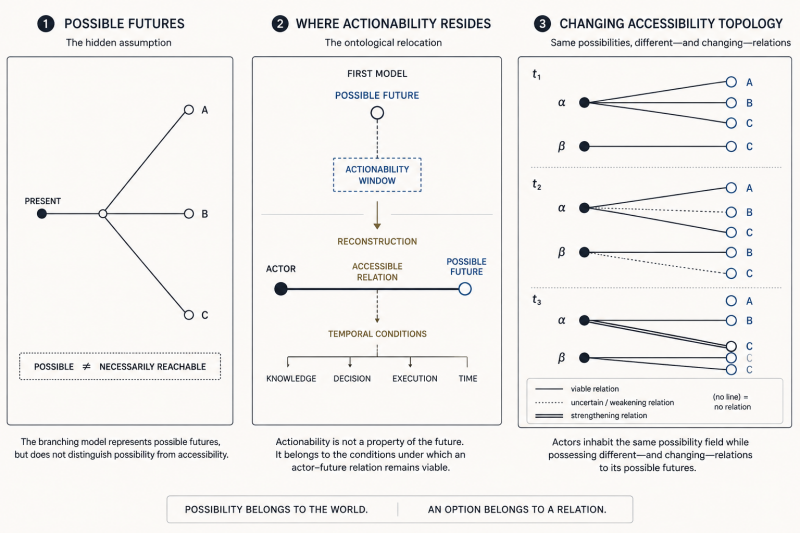
We often imagine an option as a branch extending from the present.
A / PRESENT ───── B \ C
Several futures remain possible. A decision selects one.
There is something useful in this picture. It represents a world in which more than one future can still occur.
But it also hides an assumption.
The fact that A, B and C remain possible makes them appear equally available for selection.
That need not be true.
A future may remain physically possible even after the conditions required to reach it have changed. Nothing about the future itself necessarily needs to disappear. What disappears may be our capacity to get there.
So the first question is not which branch we choose.
It is whether a possible branch is still an option at all.
Possibility is not actionability
At any moment, the state of the world permits some future developments and excludes others.
We can call the futures still permitted by a world state its possibility field:
[
\Pi(W,t)
]
where (W) represents the world state and (t) its temporal position.
This is not an attempt to enumerate every possible future. It simply separates two questions that are easily collapsed:
What futures does the present state of the world still permit?
and:
Which of those futures can actually be reached from a particular position?
These are not equivalent.
[
\text{PHYSICALLY POSSIBLE}
\neq
\text{ACTIONABLE}
]
A future can remain compatible with the state of the world while becoming unavailable for action.
Physical persistence of a possibility does not guarantee persistence of an option.
But if possibility alone is insufficient, what else is required?
A first model: the actionability window
Reaching a possible future requires conditions to coexist.
At minimum, these include physical feasibility, enough knowledge to orient toward the future, capacity to decide, and capacity to execute.
These conditions are temporal. They do not necessarily become available at the same moment, and they do not necessarily persist for the same duration.
PHYSICAL █████████████████████████
KNOWLEDGE █████████████████
DECISION ████████████
EXECUTION █████████
└────────┘ overlap
Action is possible only where enough of these conditions overlap.
We can call this an actionability window.
This gives us a first correction to the branching model. A future may remain physically possible after the conditions required to reach it cease to coexist.
At first, we might simply conclude that possible futures have periods during which they can be acted upon.
But that model becomes unstable when we examine one of its conditions more closely:
knowledge.
The observer is inside the clock
Knowing whether a possibility can actually be reached is itself an operation.
Observation produces information. Information requires interpretation. Interpretation allows evaluation. Evaluation informs decision.
OBSERVATION ↓ INFORMATION ↓ INTERPRETATION ↓ EVALUATION ↓ DECISION
None of this occurs outside time.
While we are learning whether a future remains actionable, the world in which we might act continues to change.
So two temporal processes interact:
TIME REQUIRED TO KNOW ↕ TIME REMAINING TO ACT
The process required to determine whether a possibility is actionable can consume some of the conditions required to act upon it.
More importantly, knowledge is being acquired while those conditions themselves continue changing.
Learning about the option field can occur while the option field itself is changing.
The observer is inside the clock.
And this exposes a problem with our first model.
We treated the actionability window almost as if it belonged to the possible future. But knowledge depends on an epistemic position. Decision requires a decision-capable actor. Execution depends on capacities available from a particular position.
Change the actor and the future may remain exactly the same while its actionability changes.
So:
Whose window is it?
Once we ask that, the location of the option itself becomes uncertain.
Where is the option?
Suppose a particular future (P) remains physically possible.
Two actors, α and β, inhabit the same world.
For α, the relevant knowledge, time and execution capacity exist.
α ───────── P
For β, the relation does not.
β P
Now hold the important variables still.
The world has not changed.
(P) has not changed.
We changed the actor.
Yet whether (P) constitutes an available option has changed.
Therefore an option cannot be a property of (P) alone.
That creates a problem for the intuitive equation:
[
\text{OPTION} = \text{POSSIBLE FUTURE}
]
The possible future is still there.
What differs is the relation through which it can be reached.
This suggests a different reconstruction:
An option is an accessible relation between an actor and a possible future.
The future is one term of the relation.
The actor is another.
Actionability belongs to the configuration connecting them.
This also changes how we should understand the actionability window.
Not:
POSSIBLE FUTURE │ └── actionability window
but:
ACTOR ───────── POSSIBLE FUTURE │ └── temporal conditions
The earlier model was not wrong. It had located something real: actionability can cease before physical possibility disappears.
But it had not yet told us where that actionability resides.
It resides in neither endpoint alone.
The option exists through their relation.
This gives us the central distinction:
Possibility belongs to the world.
An option belongs to a relation.
Options for whom?
Once options are relational, the question What options exist? becomes incomplete.
We have to ask:
Options for whom?
Imagine a world that still permits four possible futures:
A B C D
Three actors inhabit that world:
α A B C D β B D γ C
The possibility field is shared.
The accessible relations are not.
Therefore:
[
\text{SHARED POSSIBILITY FIELD}
\neq
\text{SHARED OPTION FIELD}
]
An option must consequently be understood relative to a bearer, a temporal position and the conditions under which access remains viable.
We might provisionally represent this as:
[
O(P,A,t,C)
]
where (P) is a possible future, (A) an actor, (t) a temporal position and (C) the relevant access conditions.
The notation is not a finished formalization. It simply prevents us from treating options as though they existed independently of the positions from which they can be reached.
Two actors can therefore inhabit the same world without possessing the same options.
And those relations can change.
The edges have histories
Return to the branching tree:
A / PRESENT ───── B \ C
It records possible destinations.
But once options are understood relationally, the edges matter too.
ACTOR ───────── A ──────── B ──────── C
And the edges do not remain fixed.
A relation may appear, strengthen, weaken, become uncertain, close, reopen or transform.
A future can remain physically possible throughout these changes.
The relevant decision landscape is therefore not only a set of possible futures. It also contains a changing structure of accessibility between actors and those futures.
We can describe this as a changing accessibility topology.
The important shift is simple:
The edges have histories.
A branching model shows where the paths lead.
A relational model must also ask whether those paths still exist from the position of the actor.
What this changes about choice
Consider a world in which A, B and C remain physically possible.
Actor α can reach all three:
α ─── A ─── B ─── C
Actor β can reach only B:
β B
Both may eventually arrive at B.
If we observe only the outcome, they appear to have made the same choice.
But the structures preceding that outcome are different.
For α, B may have been selected from several actionable futures.
For β, B may have been the only actionable future remaining.
This does not eliminate agency, nor does it imply that every difference in outcome is produced by inaccessible alternatives.
It establishes something narrower:
What appears externally as a difference in choice may sometimes be a difference in access to possibility.
Choice cannot always be understood independently of the option field available to the chooser.
And that exposes the next problem.
Why do option fields differ?
Where this investigation stops
Access can depend on knowledge, resources, authority, infrastructure, coordination, geography, skill, time, jurisdiction and institutional position.
Some actors or structures may also be able to alter accessibility for others: preserving pathways, creating them, restricting them, delaying them, or closing them altogether.
This opens questions of agency, institutions, inequality and power.
But those questions should not be answered simply because they have become visible.
The argument developed here does not establish that power determines possibility. It does not provide a general explanation for differential access. And it does not reduce choice to circumstance.
It establishes something prior:
A possible future and an actionable option are not the same object.
That distinction makes a different class of questions available for investigation.
What was missing from the tree?
The branching tree was not wrong.
It was incomplete.
It represented possible futures while leaving the conditions of access largely invisible.
Once those conditions enter the picture, we have to distinguish:
WHAT THE WORLD STILL PERMITS from WHAT AN ACTOR CAN STILL REACH
A possibility can exist without being an option.
An option can cease without the possibility itself disappearing.
And the relations that make possible futures actionable can change through time.
Possibility belongs to the world.
An option belongs to a relation.
That leaves a different question than the one with which we began:
What determines access to possibility?
Add comment
Comments