

When Coherence Becomes Enclosure
Structure, revisability, and development through transformation
We often notice structure when it becomes restrictive.
A theory can no longer accommodate what it encounters. An institution continues functioning while becoming unable to recognize what its procedures exclude. A category that once helped organize experience begins reproducing what it already expects.
This can make structure itself appear to be the problem.
But without organization there is no stable perception, cumulative memory, coordination, or sustained action.
To perceive coherently is already to organize difference.
So the problem does not begin with structure as failure.
It begins with structure as achievement.
Why form is necessary
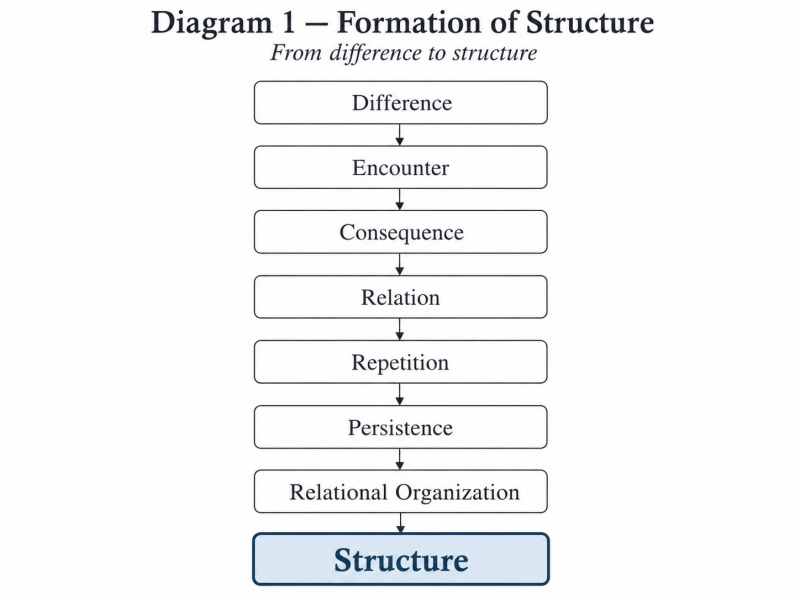
Before stable structure, there is difference: different positions, tendencies, capacities, signals, or possible relations.
Difference becomes significant through encounter. Some encounters pass without consequence. Others alter what can happen next. When consequential relations repeat and begin organizing one another, persistence appears. Enough persistence can produce structure.
A structure, in this sense, is not the deepest unit. It is a temporary realization of relational organization: a configuration stable enough to organize subsequent encounters without reconstructing itself from zero each time.
Once that organization becomes coherent, it begins to do important work.
Patterns become easier to recognize. Expectations stabilize. Memory accumulates. Relations that repeatedly matter become easier to reactivate. Some pathways become more available than others.
History enters the field.
Previous encounters now participate in shaping future encounters. A coherent structure therefore does more than respond to what is present. It carries accumulated consequences into what becomes easier to perceive and do next.
This also means that every coherent form selects.
Some distinctions become easier to perceive. Some relations become easier to connect. Others remain peripheral.
This is not yet enclosure.
Selectivity is not the opposite of openness. It is a condition of having form.
Without selection there would be no stable organization through which anything could become intelligible.
The difficulty begins when a structure encounters something consequential that its present organization cannot adequately represent.
The encounter still has to become intelligible through the structure already present.
The same form that enables perception also shapes the terms of interpretation.
When coherence becomes enclosure
Interpretation itself is unavoidable.
Every coherent structure encounters the present through a history. Existing distinctions and relations are what allow something unfamiliar to become meaningful at all.
Nor does every new difference require structural change.
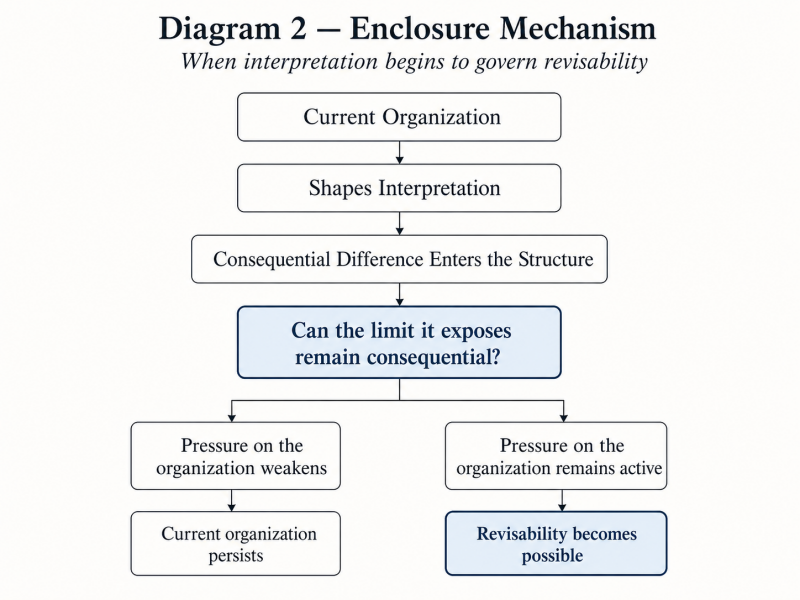
The important question appears when an encounter contains something the current structure cannot adequately realize.
What happens to that difference as it is interpreted?
Does it remain consequential enough to expose a limit in the existing organization?
Or does the organization repeatedly translate it into forms that leave its deeper relations untouched?
There need not be a dramatic act of rejection.
Alternative relations may remain weak, incomplete, distributed, or unrealized. Pressure can accumulate while the existing structure continues to function successfully. The underlying research describes precisely this possibility: a coherent organization may continue absorbing events through established categories while alternatives become harder to express or activate, even as the structure remains apparently stable.
A useful distinction appears here.
A structure may be highly open to incoming information while remaining difficult to revise.
It may gather more data, encounter more perspectives, refine its vocabulary, respond to anomalies, and change particular conclusions.
But none of these necessarily place the organization doing the interpreting under question.
Information can increase without increasing revisability.
The deeper issue is whether something encountered can remain consequential after passing through interpretation.
This is not a binary moment. A limit may remain faint for a long time. Its pressure may increase, weaken, migrate, or become visible only through later encounters.
Enclosure is therefore not simply exclusion.
A structure can become enclosed while remaining responsive, articulate, and internally coherent.
Enclosure emerges when the current organization no longer merely interprets encounters, but increasingly determines whether those encounters can reveal the limits of that organization itself.
Its way of selecting has begun to govern the conditions under which its own inadequacy can become visible.
This is why coherence can coexist with declining contact with what the structure is trying to understand.
A stereotype offers a simple example. A stabilized expectation may initially be useful compression. The deeper failure begins when that expectation becomes effectively immune to transformation and starts determining in advance what an encounter can reveal.
The answer cannot be to eliminate form.
It has to involve revisability: the possibility that a consequential encounter can place some of the current organization itself under revision.
But that introduces another problem.
Change is not development
Suppose revision occurs.
A category changes. A boundary moves. Relations are reorganized. A new structure appears.
Has development occurred?
Not necessarily.
A different answer can be produced by essentially the same organization. And a genuinely different organization can reproduce an old perceptual limitation through new categories.
The underlying architecture therefore distinguishes three levels:
change of output ≠ change of structure ≠ change of perceptual capacity.
Transformation proves that change was possible.
It does not prove that the change was developmental.
The harder question is:
What did the transformation make possible to perceive?
A reorganized structure might recognize a relation that previously remained unavailable. It might preserve a distinction that had been collapsed, locate uncertainty more accurately, or become more aware of distortions produced by its own way of observing.
Or the previous limitation may simply reappear through a different form.
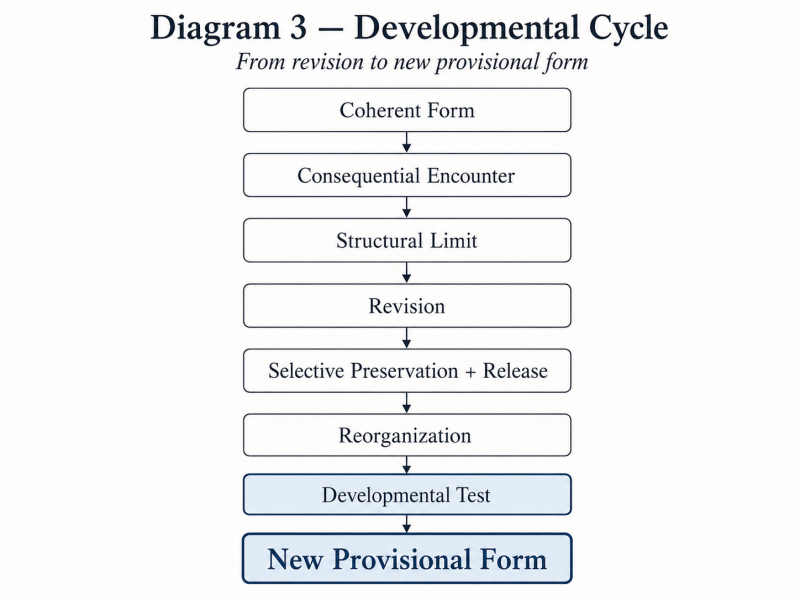
The developmental test therefore comes after reorganization.
The underlying research describes developmental gain in terms of a better capacity to realize the field: perceiving relevant relations more adequately, distorting them less, locating uncertainty better, preserving meaningful differences, and becoming more aware of observational effects.
These criteria have to be read together.
Simply perceiving more relations is not enough if the result is greater distortion. Greater complexity is not necessarily greater adequacy. And revision cannot become its own evidence of progress.
The criteria provide grounds for judgment, not yet a universal developmental score.
This matters because replacing a rigid structure with a rigid metric would merely relocate the original problem.
Development changes the observer
If structural transformation changes perceptual capacity, something else follows.
The observer entering the next encounter is no longer equivalent to the observer who entered the previous one.
Development is not simply:
the same observer + more knowledge.
The organization through which knowledge becomes intelligible may itself have changed.
Something previously treated as identical may now separate. A missing relation may become visible. A hidden assumption may become questionable. A boundary may become recognizable as inadequate. Even a question that once appeared natural may become visible as part of what organized the problem badly.
Development can therefore alter not only available answers, but the conditions under which certain questions can appear.
Yet this does not produce a final observer.
Every new coherent state becomes another temporary platform of perception. It will organize experience selectively too. Its gains will create new conditions of visibility, and its limits may become apparent only through later encounters.
Development remains recursive.
The goal therefore cannot be maximum fluidity either.
A living system requires enough memory not to restart from zero, enough coherence to maintain meaningful organization, enough difference to remain revisable, and enough release for another form to arise.
The developmental tension is:
coherence without closure
difference without disintegration
memory without imprisonment
change without total loss.
What continues when form changes?
Once structural transformation is admitted, another question becomes unavoidable.
If a structure can change substantially—or disappear—where does continuity reside?
Structural sameness cannot provide the general answer.
The source distinguishes several possibilities. In evolution, an organizing relation may persist even when its carrier, participants, language, or visible form changes. In collapse, the previous organization may lose viability while some of its consequences remain available for later reorganization. In emergence, a new relational whole can arise from conditions that existed previously without having formed that organization before.
These are different relations between history and form.
Their common implication is that continuity can reside deeper than structural persistence.
The research identifies this deeper continuity as relational history and transformational capacity.
Relational history means that later organization does not begin in a neutral field.
Previous encounters have left consequences. Some relations have strengthened, others weakened, some possibilities remained unrealized, and some structures disappeared while still altering the conditions of what could follow.
Transformational capacity means that this history can participate in new organization without requiring the previous form itself to survive.
The past can therefore remain consequential without dictating the form the future must take.
This changes what preservation means.
Development cannot preserve everything, because some relations may themselves have become part of the enclosure revision exposed.
But indiscriminate destruction is no solution either.
The source's developmental cycle therefore combines selective dismantling, preservation of viable relations, and reorganization.
The important question is not simply whether the past survives.
It is how it survives.
What remains viable can continue.
What has become enclosing can lose authority.
What failed can remain consequential without remaining sovereign.
What once existed only weakly can participate in an organization that did not previously exist.
History matters. Consequences matter. Lineage matters. But none of them require ancestry to become command.
This is the deeper meaning of memory without imprisonment.
The source ultimately places continuity not in an unchanged theory, identity, schema, or structure, but in the capacity to undergo transformation without losing the lineage through which realization became possible.
Living form
We can now return to the original problem.
We need structure because perception requires form.
But every form selects.
Coherence becomes enclosure when that selection increasingly determines whether what is encountered can expose the limits of the form itself.
Revisability keeps transformation possible.
But change alone is not development. The deeper test is what the transformation makes newly possible to perceive, distinguish, question, and understand.
And because developmental transformation need not preserve the structure that preceded it, continuity must reside deeper than structural sameness—in relational history and the continuing capacity for realization to reorganize.
Living form is therefore not simply flexible form.
It is not permanent instability.
It is not openness to everything.
And it is not indefinite preservation.
It is a form coherent enough to perceive, revisable enough for consequential difference to expose its limits, and capable of carrying history forward without making history sovereign over what may follow.
The practical movement is:
Reach the fullest coherent state presently available. Remain open to what reveals its limits. Preserve what remains viable. Release what has become enclosure. Allow another relational organization to emerge.
Boundary
This investigation does not yet establish how consequential difference should be measured, who determines which differences acquire structural consequence, how much revisability different systems require, or how power can deliberately shape the conditions of enclosure.
Those remain downstream questions.
What PO-002C establishes is the architecture beneath them:
Coherence is necessary but insufficient. Development requires forms capable of being revised by consequential encounters, while carrying relational history forward without requiring previous form to govern what comes next.
Add comment
Comments